Up, down and sideways
Christie's Corner
Up, down and sideways
July 16, 2012
Yesterday Compassion without Borders hosted our third free animal wellness and sterilization clinic in Sonoma, California. That means today I am officially exhausted. Each clinic is an incredibly worthwhile effort which enables us to bring veterinary services, vaccinations, and spay and neuter to nearly 100 animals belonging to low-income Latino families. You can find out more about the clinics here:
http://cwob.org/us-latino.html
Undoubtedly these are animals that would otherwise not receive these services and the importance of this work is clearly demonstrated by two dogs in particular at the clinic yesterday.
Chispa, the first dog, is a darling seven year old Chihuahua that I first met a little over a month ago at a previous clinic. She was brought in for possible euthanasia after she suddenly came up paralyzed on her hind limbs. Chispa’s owner, an elderly Mexican woman who spoke no English, had been recently layed off and was unable to afford even just the examination fee at a regular veterinary clinic. She had reluctantly brought Chispa in for euthanasia, since she felt there was no hope with her lack of resources.
After watching the tears stream down this woman’s face and taking one look at Chispa’s sweet face and the uncertainty in her brown eyes, I knew we had to at least try to help them. The exam revealed a spinal cord issue which was most likely related to a disk protrusion. I prescribed some pain control and anti-inflammatories, along with physical rehabilitation exercises the woman could practice at home. There were no guarantees that Chispa would walk again, but I figured it was worth a try if it could save Chispa’s life.
Imagine my elation yesterday when I saw Chispa walk up to our clinic to get her annual vaccines. Still a bit wobbly in the back, Chispa is making an amazing recovery and I expect will go on to have normal function in her hind limbs.
The next dog, Jerry, doesn’t have such a happy ending. Jerry’s owner, a soft spoken Mexican man, approached me nervously at the clinic, pushing his way through the crowd of folks waiting for our services, and asked if I spoke Spanish. When I told him that I did, he let me know his dog was very sick and needed immediate attention.
When I stepped outside I saw poor Jerry laying in a small carrier, too weak to lift his head. The man explained that Jerry, a darling chestnut colored Chihuahua mix just seven month’s old, had been vomiting and having diarrhea for nearly a week and they had not been able to afford veterinary care. They had tried some home remedies, but the dog was clearly not responding.
I asked just one question after hearing this – was Jerry vaccinated? When I found out he wasn’t I was sure of the diagnosis, Parvo.
Parvo virus is a highly fatal virus that affects unvaccinated animals, and is particularly lethal in puppies. It is easily prevented with routine vaccinated, but causes horrific suffering and often times death once contracted.I brought Jerry in and did an exam and a test for Parvo, which came up positive.
My heart sank. Jerry’s condition was very advanced and he was going to require extensive treatment, and even with it there were no guarantees.
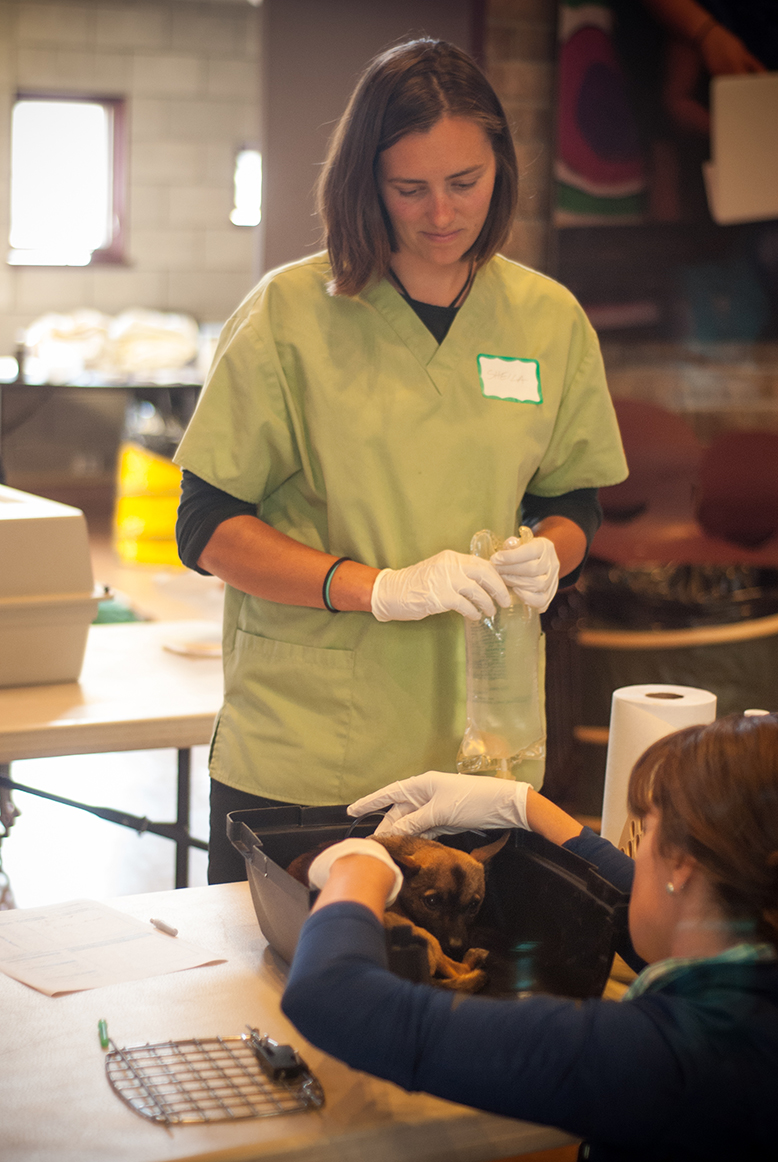
So, I did the only thing I could do, I tried. I gave fluids, anti-emetics {to control nausea}, antibiotics and other gastrointestinal medications doing everything possible to help. Yet, by the end of the day it was clear that Jerry was declining even despite extensive veterinary intervention. He was so ill it appeared he would die on his own if not helped along by humane euthanasia. I made the painful decision to euthanize to ease his suffering.
As I delivered the news to his owner, he went outside and gathered his family. Three small children under the age of 10 and his wife. They stood around Jerry sobbing as they said goodbye. The youngest, a small girl just 3 or 4 years old, had to be carried away she was so hysterical.
This painful reality could have easily been avoided. With just a simple vaccination Jerry would be alive today. These people clearly loved this dog but lacked the resources and knowledge to adequately care for him.
That is what our Local Latino clinics are about, helping animals just like Jerry through education and outreach and by providing lifesaving services which often time are as simple as a routine vaccination.
This work is more than just exhausting, it is an emotional roller coaster. From the dizzying high of seeing a dog like Chispa recover despite the odds thanks to our care to turning around and looking into the face of a sobbing toddler as I hold the euthanasia syringe in my hand and face the prospect of ending the life of a darling seven month old dog that is dying needlessly.
It’s hard work, in so many ways. Even when at the core of my being I know we are making a difference, I can’t help but be saddened by those we weren’t able to help and that slipped through the cracks.
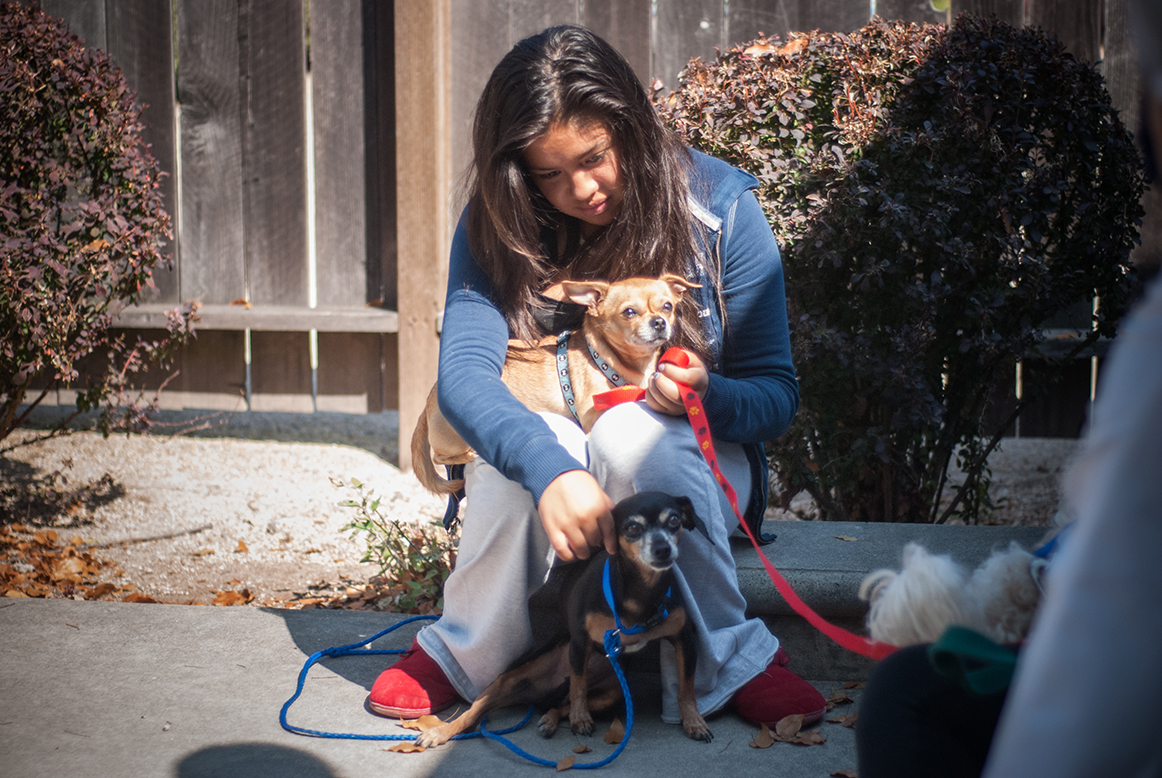
Below are pictures of Jerry receiving treatment and Chispa – she is the little black dog with the blue leash